Skip to content

The Farm

Why are we farmers?


What we make has always been good - transforming rescued materials into wonderful pieces and donating half of our profits was a great start. But we wanted to do more. That ambition needed land. In December 2020 we became the custodians of New Barns Farm.


What did we start with?


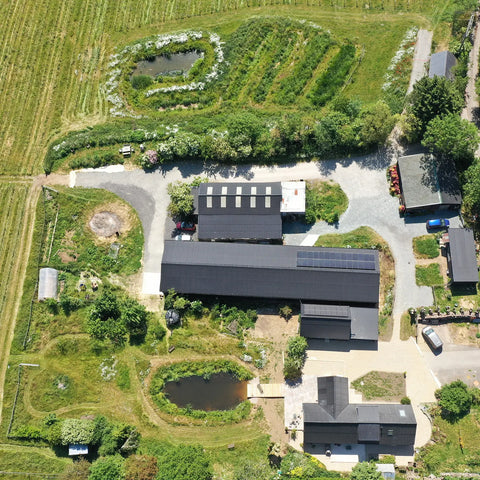
New Barns Farm is 17 acres of south facing chalk slopes near Faversham in Kent. It was marketed as Grade 3 degraded pasture, which means soil that is very poor but not yet barren. We later learned that a previous owner ran a turf cutting business here; they sold the soil itself. Worm counts were low and there wasn’t a dung beetle in site. The buildings all needed major repair or demolition and the septic system had failed. In other words, it was perfect for us. 


The goal?


Bring this sad place back to a state of overwhelming abundance and prove that businesses can be regenerative by design.

Before
After

What Regenerative Means to Us


It means that we do exponentially more good than bad.

We didn’t want these commitments to be ‘nice-to-haves’, easy to drop in hard times, we wanted them to be in our DNA. We are product designers by trade, but we believe everyone who owns or runs a business can be a business designer too. You can design, or redesign yours to have a genuinely positive impact.

Expanding our regenerative mission meant doing more than rescuing materials and donating 50% of profits to charity. We now hold ourselves to four additional measurable commitments:

  • Clean more water than we use
  • Enhance biodiversity
  • Sequester more carbon than we emit
  • Generate more renewables than we consume

Soil carbon has more than doubled since we arrived. That is what this looks like in practice, not just in principle.


The Wetland


Every drop of wastewater this farm produces is treated on site, naturally. We have no septic tank, we use no chemicals, and nothing is trucked off the property. Sewage isn’t a problem, it is an opportunity!

Our wetland is a passive, nature-based treatment system: waste moves through a separator, solids compost down in a worm-filled chamber (finished vermicast in around nine months), and the liquid filters slowly through 120 metres of soil, roots and planted swales before reaching a pond clean enough to swim in.

It took a year to establish, planted in phases across autumn and spring. What it does for the farm goes well beyond sanitation: water brings life, and life brings biodiversity - insects, amphibians, birds. Our wetland is now home to newts and endangered bird species, and it recharges the aquifer beneath the farm rather than draining it. Since the 1900s, England has lost around 500,000 ponds - up to 75% of the historical total. Water brings life, it fosters biodiversity, and our 7 ponds were the perfect place to start.


Marbeled white on a wild orchid

Cherry Plums

Wild Marjoram

Our First Newt Count

Trees, before the vines


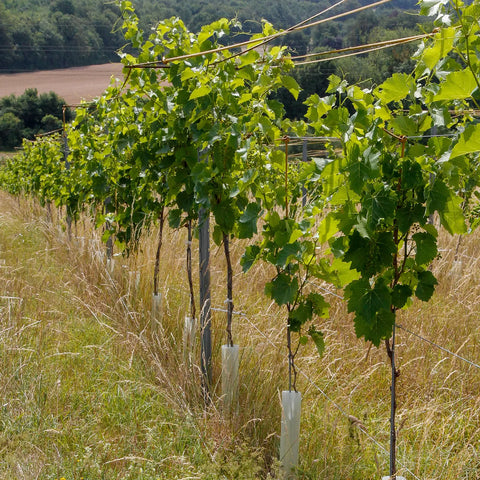
Before we planted a single vine, we planted trees - more than 3,000 of them across over 40 species, alongside companion planting and biodiverse food crops: apples, plums, cobnuts, mulberries, and pears. And we haven't just planted trees to surround the farm, they are also woven through the vineyard. This is an ancient agricultural practice known as vite maritata, and allows for the symbiotic flourishing of vines grown with trees. This pre-Roman technique was largely abandoned in favour of industrialised farming but is having a resurgence as we re-learn that the trees can help with shade, resilience and biodiversity.


Waste, an ongoing obsession


We feed our land and vines with waste!

We use living biology to improve our soil and feed our vines. We do this by making compost and compost tea.

Our compost is made from locally available waste: horse manure from our neighbours, food waste from our favourite local farm shop, Macknade, and then we layer in other green and brown (living and dead) vegetation, cuttings and chippings from the farm that we store up through time. Effectively we 'recycle' the nutrients on our farm - there is no 'agricultural waste'.

Once we have got a really good compost, and we have checked it under the microscope, we brew it - about 30kg of compost across 5 large reusable 'tea bags' are suspended in a conical vat of water that is bubbling. The oxygenation encourages the microorganisms in the compost to reproduce and spread through the 2000L brew. We then dispense this out into the farm, sometimes into the soil, sometimes directly onto the vegetation. This is our alternative to synthetic fertiliser.

It poses a question - does the UK need to import expensive fertilisers at a great financial and carbon cost? Or do we need to recycle our own nutrients much more effectively?

And because we love their manure, we also created a home for a small flock of cull ewes - sheep that would otherwise have been slaughtered - rotationally grazing them for four years until the vines grew too tempting for their noses. The sheep will return when all the vines reach their full height.


This is just the beginning

Five years ago this farm had no workshop, now it has our straw bale, renewably powered workshop that cut our power consumption by 94.7%.

This land had almost no wildlife. Now it has newts, red-listed birds, double the soil carbon (which essentially means twice the amount of living things in the soil), and our first harvest is now in the bottle. Not a single chemical has ever touched it. Read about the vines and that first harvest: The Vines, or become part of everything that comes next: Friends of the Farm.

Building the Straw Bale Workshop

Our Solar Panel Powerstaion

Building A Compost Heap

The girls - one of their many escapes

LATEST NEWS

Our latest news!

House & Garden
#greenbydesign#hattabyng#houseandgarden

House & Garden

The 2011 Feature in House & Garden This is a throwback post - although we are more known for products than interiors, our interior practice is growing and it has been doing...
Elvis & Kresse at London Craft Week
Elvis is hosting a 'Design Your Own' Workshop at Sotheby's Normally our workshops, where you can create your own entirely unique piece, are all hosted at our farm/HQ in Kent. This is...
The Elvis & Kresse Farm from the air
Everyone who comes here says they want to stay... Well, now is your chance. Our Yard House is available at a low, all inclusive rent, and we are searching for either an...
E&K + Gotham Newcastle
Introducing Hotel Gotham x Elvis & Kresse! We have been working with hotels for years now - but this collaboration is really significant. And it comes with a great offer for our...
Elvis & Kresse are proud to be one of the first companies to gain B Corp status in the UK
March is B Corp Month  - essentially a time for all B Corps to come together, celebrate, collaborate and challenge themselves to increase their impact. We have written a lot about why...
Willow Harvest, You Are Invited!
JOIN OUR WILLOW HARVEST   This is an invitation you don't want to miss. We would love to welcome you to join our willow harvest now, and then come back in summer...